
 Character Options
 LEGO
LEGO Flair Leisure
 Hasbro
 Mattel
 MGA
MGA Moose
Moose Spin Master
 Vtech Electronics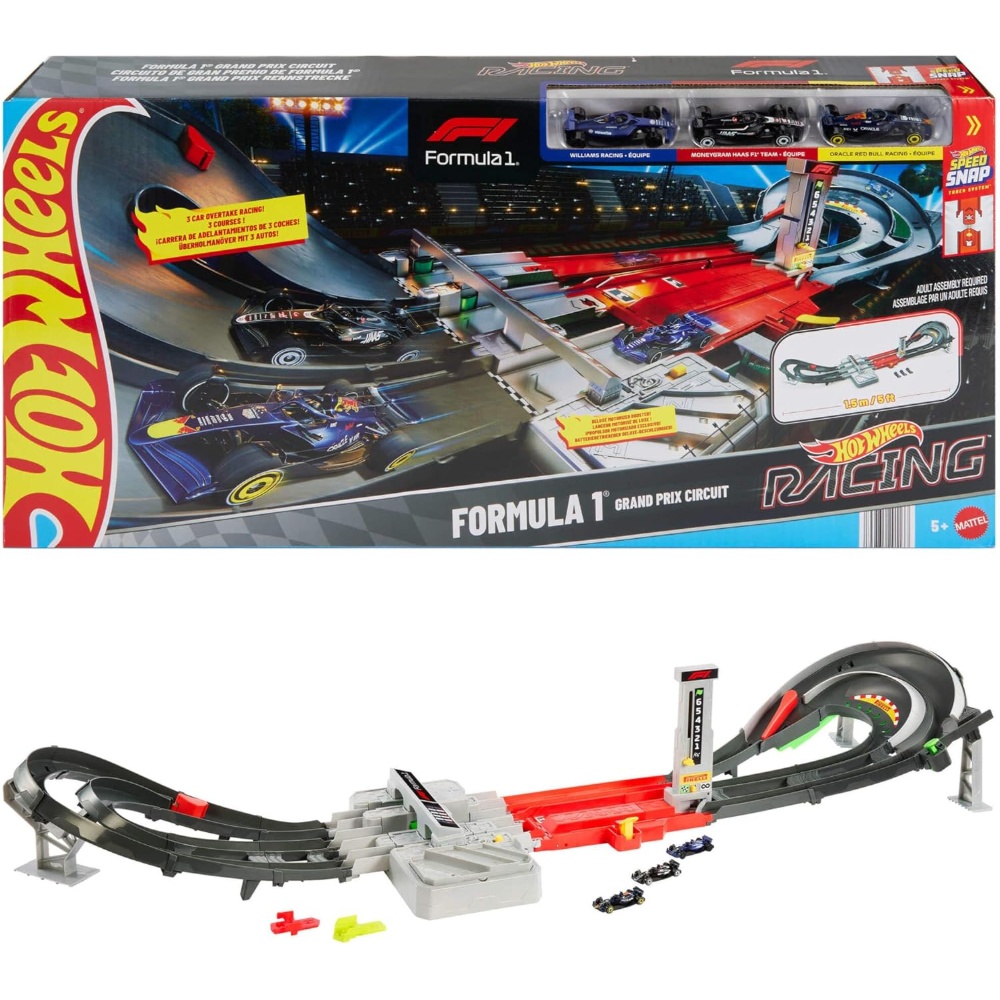
Hot Wheels F1 Circuit Parent Guide
Hot Wheels F1 Circuit Parent Guide
Hot Wheels F1 Circuit Parent Guide gives parents a clear, practical understanding of how this track-based racing set functions during everyday home play. This guide explains setup, safety, age suitability, durability, troubleshooting and long-term storage so families know exactly what to expect before and after unboxing. The aim is to help parents create a smooth, predictable play environment that supports independent and imaginative racing sessions.
What’s in the Box
The Hot Wheels F1 Circuit typically includes modular track pieces, connectors, one or more launching sections, themed curves, decorative elements and an F1-style Hot Wheels vehicle. Depending on the version, it may feature additional track components such as a podium, flags or small accessories that enhance the racing theme. All track pieces connect using the familiar Hot Wheels clip-and-slot design, allowing children to assemble simple or extended circuit layouts.
Families wanting more insight into the wider product range can visit the Mattel brand page. This helps when deciding how well the F1 Circuit will integrate with existing Hot Wheels sets or whether additional track packs or vehicles would complement the layout.
How It Works
While building this Hot Wheels F1 Circuit Parent Guide, we analysed how children use the circuit to control speed, distance and direction. The track operates as a guided raceway: children assemble the pieces, place their F1-style car at the starting point and either launch it with a manual mechanism or push it forward to begin the race. The curved sections are engineered to keep cars aligned at moderate speeds, while straight sections allow faster acceleration.
The modular layout encourages experimentation. Children quickly learn that adjusting the angle of curves or the length of straights changes the car’s behaviour. This natural trial-and-error process fosters early understanding of momentum, friction and simple physics. Younger children enjoy watching the car glide through the circuit, while older children may stage time trials, head-to-head races or variations in starting power to test performance.
Setup, Space & Batteries
Setup involves snapping track pieces together, securing connectors and ensuring all sections are firmly aligned. Parents may want to help with the initial assembly, especially if the circuit includes tight curves or elevated areas. Once the base layout is built, children can rearrange or extend the circuit independently.
No batteries are required, which keeps the toy low-maintenance. However, families should provide a large, clear floor space—such as a hallway, playroom or living room—to accommodate long track runs. Hard flooring generally produces smoother results than thick carpeting, which may cause the track to shift or disconnect. Avoid setting up near doorways or areas where foot traffic might interrupt races.
Best Age Range & Suitability
The F1 Circuit is generally ideal for children aged 4 and up. Younger children enjoy the sound and spectacle of the car speeding around the track, while older children benefit from designing different circuit shapes and comparing the performance of various vehicles. Because the track pieces are lightweight, children with developing motor skills can handle them comfortably.
The set supports shared play well. Children can take turns launching cars, arranging challenges such as “fastest lap,” or collaborating to design larger circuits. The F1 theme also appeals widely, giving children a recognisable context for races and role-play scenarios.
Safety Notes
Parents should ensure that all track sections are firmly connected before children begin high-speed launches. Loose connectors may cause cars to jump the track unexpectedly. Children should avoid leaning heavily on elevated track areas, as these can bend under weight and affect car movement.
Because cars can travel quickly, supervision is recommended for younger children to prevent vehicles entering walkways or colliding with objects. Long hair, loose cords and small objects should be kept away from the track to prevent snagging or obstruction.
Durability, Cleaning & Storage
The track pieces are built from flexible plastic designed to withstand repeated assembly and disassembly. Curved sections may loosen slightly over time but generally remain functional with careful handling. The included F1 car is durable enough for everyday play, though wheels should be checked periodically for dust or debris that could interfere with smooth rolling.
Cleaning involves wiping track pieces with a damp cloth to remove dust or fingerprints. Avoid using harsh cleaners or soaking components. For storage, the track can be disassembled and stacked flat, or kept partially assembled if space allows. Many families store track pieces in a large plastic tub or under a bed to keep everything contained between play sessions.
Common Issues & Troubleshooting
Car slowing down too quickly: Ensure that track connections are smooth. Gaps or misaligned sections can hinder movement. Cleaning the wheels or using a firmer launching motion can also improve speed.
Track pieces disconnecting during races: Re-seat connectors firmly, and consider placing the track on a non-slip mat. Uneven flooring can cause tension points that loosen clips.
Car jumping off curves: Reduce launch speed or adjust the curve angle. Some children enjoy testing high-speed launches, but moderating the start often improves stability.
Tips
One helpful way to use this Hot Wheels F1 Circuit Parent Guide is to introduce “race engineering” ideas. Encourage children to test different track shapes, adjust the angle of the starting ramp or compare how different vehicles handle curves. This encourages prediction, experimentation and early problem-solving.
Parents can also create themed challenges such as “pit stop moments,” where children rearrange part of the track mid-session, or “qualifying laps,” where the same car completes the circuit multiple times to beat its own record. These simple variations keep engagement high and extend the life of the toy without requiring additional accessories.
Alternatives
Families who enjoy the F1 Circuit may appreciate other Hot Wheels track sets that emphasise racing, loops, jumps or stunt features. These pair naturally with the circuit and offer new possibilities for extended layouts. Larger garages or multi-level track hubs also complement the set by providing storage and thematic structure for racing sessions.
If your child prefers imaginative play over racing, consider playsets with character themes or interactive elements. Children who enjoy fine motor building may gravitate toward construction-based track systems or modular toys that allow more structural variation.
Quick FAQs
Does it work with all Hot Wheels cars?
Yes. Most 1:64 scale cars work well, though extremely heavy models may slow on long curves.
Is assembly difficult?
No. Most families complete setup within minutes.
Does it require batteries?
No. The toy operates entirely through manual launching.
Does this support learning?
Yes. The set promotes experimentation, coordination and simple physics awareness.
What does the Hot Wheels F1 Circuit Parent Guide cover?
Setup, safety, storage, troubleshooting and practical play tips for families.
Where Next?
Explore full product details on the Hot Wheels F1 Circuit page.
For hands-on impressions and deeper observations, visit the Hot Wheels F1 Circuit Review.
Some links on our site are affiliate links. If you buy through them, we may earn a small commission — at no extra cost to you. 🎄